
Trust and the Scorpion
A personal update about transformation and new beginnings
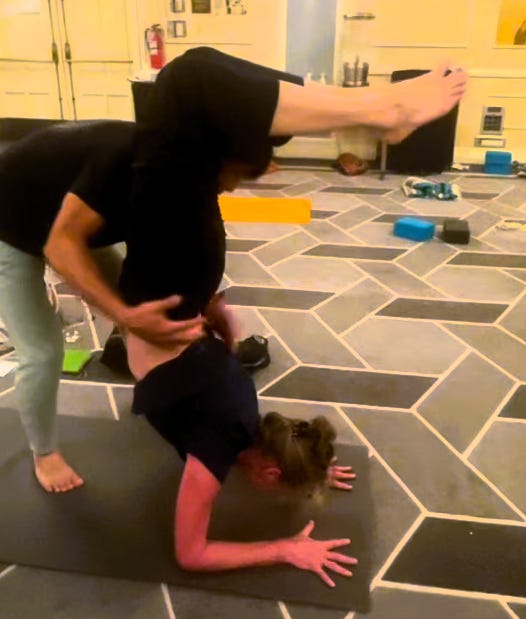
This month, I attended Samavesha, the global Anusara Yoga Conference, and signed up for a session called “Fearless Backbends.” What the program description did not mention: we were also going to be going upside-down.
My yoga practice goes back to 1999, and I was fortunate to discover the Anusara tradition very early. It is a form of Hatha yoga built around precise actions and alignment principles to support each pose. Its focus on biomechanics appealed to my slightly nerdy side. And the teachers made even those of us who had avoided gyms since middle school feel welcome.
At first, the physical practice itself was plenty challenging, and very rewarding. My self-confidence grew; I felt more powerful and more at ease in my own body. Over time, I began to experience and learn more about other parts of the yoga practice: the philosophical foundations, breath work (pranayama), meditation, anatomy, neuroscience. I learned about the difference between movement and action.
Soon, the benefits of my yoga practice began to extend well beyond the mat. Once again, at first, this was physical: applying the Anusara Universal Principles of Alignment while carrying heavy groceries, for instance. Then, I learned to use breathing techniques to help manage emotions such as fear or anxiety, and to become more mindful of the triggers that would lead me to react to various situations in ways I would later regret. It was at this stage that noticed how my yoga practice was showing up in my professional life, too.
Getting my yoga MBA
Today, I apply skills and principles from my yoga practice in my professional life every day. I use my yoga skills to show up in a way that is more true to myself in professional relationships. I know how to slow my breathing, calm my mind, and gain clarity. I’m working on honing my buddhi, the part of the mind associated with inner wisdom and discernment.
I also use lessons from my yoga practice to analyze business strategies. For example, the Anusara 3A’s teach us that Attitude and Alignment must precede Action. If your corporate strategy isn’t working, odds are pretty good that you haven’t take the time to define a shared intention or mission (Attitude), and made sure your people, systems, and processes are prepared to support it (Alignment). Only then does any corporate Action have a chance to succeed.
This is a mental checklist I initially learned in my physical yoga practice—what’s my intention and am I tuned in to my body? How can I create biomechanical alignment so my actions are both safe and expansive? Exactly what muscle systems am I engaging, and how?
Today I also use the three A’s to evaluate almost any kind of business problem I encounter. They are amazingly clarifying as a strategic lens.
Upside-down and backwards
I’ve always loved backbends, and I enjoy a good thrill. So of course I signed up for “Fearless Backbends”! By the time I found out about the upside-down part, it was too late to escape and hide my fearlessness in the other room.
For me, inversions have always been more terror than thrill. I mean … how am I supposed to keep my balance when I can’t tell my left from right or front from back because my relationship to gravity and the world is completely inverted!!?? With practice, and working in stages, I have learned to kick up and hold headstand, sometimes even without support. But anytime I’ve tried to kick up into a handstand or forearm inversion, a part of my brain goes “absolutely not!!!” and I collapse into a heart-pounding puddle of yikes.
But somehow, something was different that day. I was surrounded by other fearless yogis. I had spent several days at the yoga conference, focused on small details of alignment and considering new aspects of the practice.
Most of all, I wanted to become a scorpion. I was ready to trust myself. What happened that day was not just an achievement (and a long way from a full scorpion pose). It felt like a transformation.
Trust and Transformation
Holding your body upside down is disorienting. You have to invert your relationship to gravity. You have to move backwards in space, not forwards. You are vulnerable, and the only solution is to find a new relationship to gravity and space and yourself.
Practice and principles can take you part of the way. But to cross into new territory, you also need to let go of emotions such as fear or the need for control, step across a chasm, and accept the unknown. To carry you into unfamiliar terrain, you need trust.
When I came out of my first-ever scorpion pose, I felt like a different person. After the experience of being in an upside-down backbend, I felt energized, dynamic, and ready to use that energy to propel myself forwards. It was as if some kind of starting gun had gone off. I walked away from that session with a sense of new beginnings and possibility. And I was feeling really excited to fully step into the next stage of my career.
Over the next few months, I’ll share more about that next stage and what it looks like. Like my Scorpion pose, it involves leaning into past experiences to create forward momentum. I’ll be drawing on my years of studying trust, but also my years of helping clients solve business problems and navigate industry disruptions. I hope to incorporate some of the things I’ve loved about previous stages: the joy that can be found in the camaraderie of a team on a shared mission. The satisfaction of solving problems and delivering solutions. The thrill of having clients who are so satisfied that they recommend you to others.
I’m also excited about the many things that will be different. We’re building with AI, both as a tool and as a foundation for the business. The potential for new business models and structures. A new way of thinking about trust and its role that makes all the pieces fit into place.
If you’re curious to learn more—especially if you or your business is navigating its own inversion or transformation—reach out for a private conversation. And if you want to start working on your own Scorpion journey, here’s a good starter guide.
A very interesting perspective! I look forward to your future content on this particular manifestation of trust.